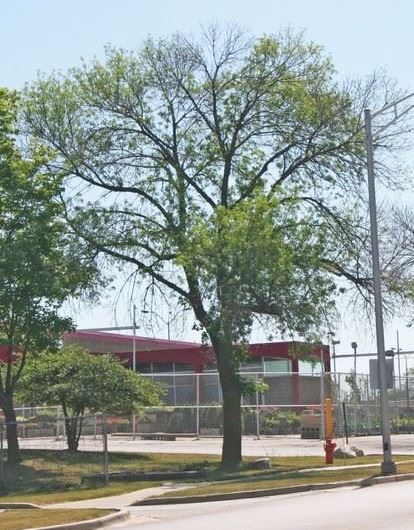
Emerald Ash Borer
Photo courtesy of the Morton Arboretum
What is it?
Originally from Asia, the emerald ash borer (EAB) was first discovered in the Detroit area in 2002. It is believed to have entered the country on wooden packing materials from China. The bright metallic-green beetle may be smaller than a dime, but it is capable of taking down ash trees thousands of times its size. Adults are typically ½ inch long and ⅛ inch wide. Eggs are extremely small — approximately 1/25 inch— and are reddish-brown in color. Larvae are white, flat-headed borers with distinct segmentation. Adults usually emerge in mid- to late-May from infestations to trees during the previous year, with females laying their eggs shortly after. The larvae bore into the ash tree and feed under the bark, leaving tracks visible underneath. The feeding disrupts the tree’s ability to transport water and nutrients, resulting in dieback and bark splitting.
What is the threat?
Ash trees are one of the most valuable and abundant North American woodland trees: estimates place the total number of ash trees in the United States alone up to 9 billion. The emerald ash borer has destroyed 40 million ash trees in Michigan and tens of millions throughout other states and Canada. Small trees can die as soon as one to two years after infestation, while larger infested trees can survive for three to four years. Heavy infestations of larval borers speed up the devastation of formerly healthy trees.
Where is it?
The emerald ash borer primarily lives in the midwestern and eastern United States and parts of Canada, but is spreading fast. For a list of locations where EAB has been confirmed, check out emeraldashborer.info. EAB was confirmed in Madison County in 2015.
What can you do?
Know the symptoms of EAB: thinning or dying of ash tree crowns, suckers at the base of the tree, splitting bark, tunneling under the bark, D-shaped exit holes and woodpecker activity.
The United States Department of Agriculture (USDA) recommends the following to help manage this pest:
- Do NOT move firewood. EAB larvae can survive hidden in the bark of firewood. Remember: buy local, burn local.
- Inspect your trees. If you see any sign or symptom of an EAB infestation, contact a local certified arborist.
- Talk to friends, neighbors and co-workers about EAB and what they should be aware of on their trees.
- If you receive firewood, know its origin and your supplier, as larvae could be hiding under the bark.
- If you think you've seen the emerald ash borer or ash tree damage caused by an infestation please contact your local arborist.
Photo courtesy of the Morton Arboretum
Resources
- For information about preventative measures and potential treatments read Insecticide Options for Protecting Ash Trees From Emerald Ash Borer or contact a local certified arborist.
- More information on Emerald Ash Borer can be found at: emeraldashborer.info, the Morton Arboretum Plant Clinic, or U of I Extension Service.
- For information on Ash tree identification, visit U of I Extension Ash Tree Identification